
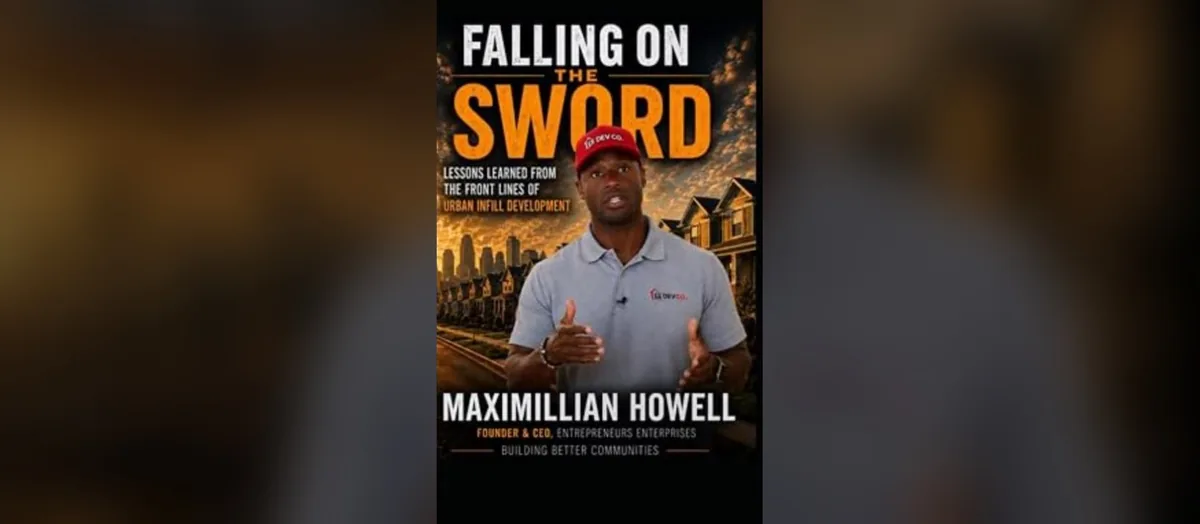
Falling on the Sword: Lessons Learned From the Front Lines of Urban Infill Development
Somebody has to say it out loud.
Urban infill housing is messy. The permits stall. The neighbors show up to city council meetings. The financing structures read like a graduate-school exam. The vacant lot that looks like a simple project on paper turns into a two-year education in everything you thought you knew about development.
And yet, filling in those vacant lots with new construction housing is one of the most powerful tools we have against the American housing shortage. The gap between what infill should be and what it actually takes is enormous, and not enough people are talking about it honestly.
This book does.
Falling on the Sword: Lessons Learned From the Front Lines of Urban Infill Development is a candid, street-level account of what urban infill new construction really looks like when you are the developer holding the shovel (figuratively) and the signed contracts (very literally). It is not a glossy case study. It is a field manual written in scar tissue.
Why Urban Infill Housing Matters Right Now
The American housing shortage is not a rumor. Communities across Missouri, Kansas, and the country are grappling with a deficit of attainable housing that cannot be solved by building on the suburban fringe alone. Sprawl has real costs: infrastructure, transit, environmental impact, and the slow hollowing-out of urban cores that once held working families.
Vacant lot development inside existing city boundaries offers a different path. When a new construction developer builds on an underutilized infill parcel, they are not just adding a unit to the housing stock. They are:
- Reactivating tax-generating land that has sat idle.
- Reducing blight and its ripple effects on surrounding properties.
- Connecting residents to existing infrastructure rather than requiring new roads, water lines, and utilities to be extended.
- Contributing to the affordable housing crisis solution that policymakers keep promising and communities keep waiting for.
Urban infill housing, done right, is a triple win for the developer, the city, and the people who need a place to live. The operative phrase is done right.
What Nobody Tells You Before You Break Ground
The gap between the promise of infill development and the practical reality of pulling it off is where most projects lose time, money, or both.
Here is a short list of things that tend to surprise first-time infill developers (and sometimes veterans):
Entitlements are not guaranteed. A lot zoned for residential use is not a lot approved for the project you have designed. Variance requests, neighborhood input meetings, historic review boards, and utility easement conflicts are all capable of adding months to a timeline.
Financing structures are layered for a reason. Affordable housing development in particular often involves tax credits, HUD programs, HOME funds, and conventional debt stacked in ways that require every lender to agree before a single footing gets poured. If one piece moves, the rest of the stack shakes.
The site itself will surprise you. Infill parcels in urban cores have histories. That history sometimes shows up as buried debris, environmental contamination, or utility conflicts that no survey fully predicted. Budget for discovery.
Community trust is a project input, not a PR exercise. Residents near a proposed infill project have often watched previous development promises fall apart. Earning genuine buy-in requires showing up early, listening more than presenting, and following through on what you say you will do.
Your contractor relationships determine your outcome. Self-performing concrete and finish work, maintaining W/MBE engagement with real documentation, and running a LEAN construction process are not just values on a website. They are the operational decisions that keep an infill project on schedule and in compliance.
The Case for Radical Transparency in Development
Most development firms publish success stories. Project complete, ribbon cut, photo taken.
What gets left out are the twelve decisions that nearly sank the project, the financing round that fell through two weeks before closing, the inspector who found the problem nobody budgeted for, and the subcontractor who disappeared mid-schedule.
Those stories are where the real learning lives.
Falling on the Sword was written from that place. The title is intentional. Falling on the sword means owning the mistakes, naming what went wrong, and passing along the hard-won knowledge so the next developer does not pay the same tuition.
If you are a new construction developer working on vacant lot development in an urban market, or an aspiring one trying to understand what infill actually requires, that transparency is worth more than a highlight reel.
What the American Housing Shortage Needs From Developers
The affordable housing crisis solution is not one thing. It is a combination of policy reform, financing innovation, community partnership, and developers who are willing to operate in markets that require more patience and skill than greenfield suburban builds.
Urban infill new construction housing is not the easiest path. It requires:
- Deep knowledge of local zoning and entitlement processes.
- Relationships with municipal housing agencies and financing intermediaries.
- An in-house or closely managed construction team that can handle complex, constrained sites.
- Commitment to W/MBE participation that goes beyond paperwork.
- Passive House and energy-efficiency practices that reduce long-term operating costs for residents.
None of that is simple. All of it is learnable. And the developers who figure it out are the ones who will help close the gap between housing supply and housing need in American cities.
Building a Better Community Is Not a Tagline
At the core of every infill project is a community that existed before the developer arrived and will exist long after the ribbon cutting. The measure of a good infill project is not just certificate of occupancy. It is whether the people who live nearby, and the people who move in, are genuinely better off.
That standard requires humility. It requires a willingness to learn from failure rather than bury it. It requires, occasionally, falling on the sword.
The book is an invitation to do exactly that, and to build better because of it.
Get the Book
If you are working in urban infill development, thinking about vacant lot development, or trying to understand how new construction developers operate in complex urban markets, Falling on the Sword: Lessons Learned From the Front Lines of Urban Infill Development belongs on your shelf.
Pickup your copy on Amazon and start reading the lessons before you pay for them the hard way.